Home>Blog>How to Estimate What Your Gold Jewelry Is Worth Before Selling It
Blog
How to Estimate What Your Gold Jewelry Is Worth Before Selling It
Table of Contents
- Your Starting Numbers
- Understand What Melt Value Actually Measures
- Check the Purity Before You Reach for a Calculator
- Measure the Metal Weight You Can Reasonably Estimate
- Convert the Gold Price Into the Same Unit
- Work Through an Example Before Requesting Quotes
- Understand Why Offers Differ From Your Estimate
- Compare the Cash You Will Actually Receive
- Give the Proceeds a Household Job
- Let Your Estimate Set the Starting Point
That broken chain in your drawer could help cover a repair bill. Your old wedding band might add to an emergency fund. Before you accept a buyer’s offer, though, give yourself a starting number. Knowing roughly how much gold your jewelry contains can turn an uncertain transaction into a more informed money decision.
You can estimate its melt value with three inputs: weight, gold purity, and the current price of gold. That estimate will not tell you exactly what a buyer should pay. It will give you a benchmark for comparing quotes, spotting unexplained deductions, and deciding whether the cash is worth giving up the piece.
Your Starting Numbers
- Weigh jewelry in grams and separate pieces by gold purity.
- Exclude stones and other materials from the gold weight.
- Multiply estimated pure gold weight by the current price per gram.
- Compare final payouts after every fee and deduction.
- Choose a purpose for the proceeds before agreeing to sell.
Understand What Melt Value Actually Measures
Melt value estimates the market value of the gold contained in an item. It does not include the original store markup, craftsmanship, sentimental meaning, or a separate value for gemstones.
This explains why an expensive necklace may receive a much smaller scrap offer than its purchase price suggests. You originally paid for a finished product. A scrap buyer mainly pays for recoverable metal.
The distinction also works in your favor. A signed designer bracelet, antique ring, or desirable vintage piece could sell for more as wearable jewelry than as scrap. Before treating an intact piece as raw material, check whether it deserves a resale assessment. An insurance replacement appraisal answers a different question and does not establish what a buyer will pay today.
Check the Purity Before You Reach for a Calculator
Look inside a ring’s band, near a necklace clasp, or on an earring post for a purity mark. Karats describe how much of an alloy is gold, using 24 parts as the reference. A 14K piece contains 14 parts gold out of 24, or about 58.3%.
Common marks include 10K, 14K, and 18K. You may also see numerical marks: 417 generally represents 41.7% gold, 585 represents 58.5%, and 750 represents 75%. The Federal Trade Commission explains these distinctions in its guidance on gold purity.
Use the marking as a starting assumption. A stamp alone cannot prove authenticity, and an older or repaired piece may contain components with different gold content. Ask buyers how they test purity and whether their method could leave a mark or otherwise affect the item.
Gold-plated, gold-filled, and vermeil items require different treatment. Their total weight is not solid karat gold. Applying a 14K calculation to an entire gold-plated bracelet can greatly overstate its gold value. Set these pieces aside for a separate assessment.
Measure the Metal Weight You Can Reasonably Estimate
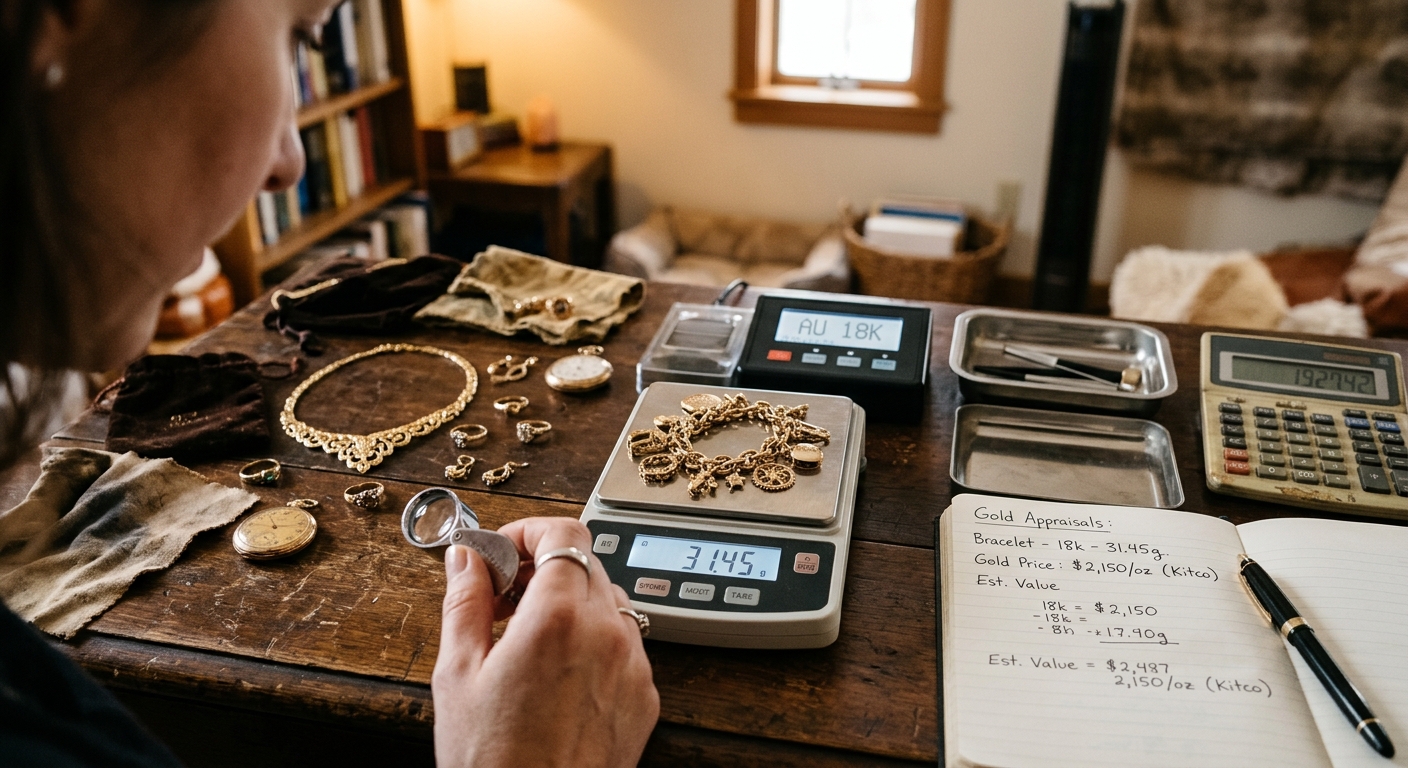
A digital scale that reads in grams is useful for a home estimate. A kitchen scale that rounds to whole grams may be too coarse for a lightweight ring or single earring. Place the scale on a stable surface and check that it reads zero before weighing anything.
Keep different purities separate. Combining 10K earrings with an 18K chain creates an extra calculation and makes a buyer’s breakdown harder to check.
Your scale measures everything on it. Stones, pearls, steel springs, and other nongold components can inflate the result. If a ring weighs 8 grams with a large stone, you cannot assume it contains 8 grams of gold alloy.
Do not pry stones out yourself just to improve an estimate. Record the full weight and label the metal weight as uncertain. Ask the buyer to explain any deduction for stones or other components. For hollow jewelry, the scale already measures the material present; there is no need to subtract weight for the empty space.
Convert the Gold Price Into the Same Unit
Check current metal prices shortly before requesting quotes. Look for gold priced in US dollars and confirm whether the figure is per gram or per troy ounce. Record the price and the time you checked it, since a later offer may use a different market price.
A troy ounce contains approximately 31.1035 grams. It differs from the ordinary ounce used for groceries and household measurements. Using the wrong ounce conversion will distort your estimate.
If gold is quoted per troy ounce, divide that price by 31.1035 to calculate the price per gram of pure gold. If the source already provides a pure gold price per gram, you can use that figure directly.
Estimated melt value = gold alloy weight in grams × purity fraction × pure gold price per gram.
Keep the units consistent throughout. A buyer may quote weight in pennyweights, abbreviated dwt. One pennyweight equals approximately 1.5552 grams. Ask for a gram equivalent if that makes the comparison easier.
Work Through an Example Before Requesting Quotes
Suppose you have a plain 14K chain weighing 12 grams, with no stones or known nongold components. For illustration only, assume pure gold costs $100 per gram. This is a hypothetical price, not a current market quote.
- Calculate purity. Divide 14 by 24 to get approximately 0.5833.
- Estimate pure gold weight. Multiply 12 grams by 0.5833 to get approximately 7 grams.
- Calculate melt value. Multiply 7 grams by $100 to get approximately $700.
- Compare the offer. A $560 payout equals 80% of that estimated melt value.
That 80% figure describes the example. It is not a universal fair-price rule. Actual offers depend on the item, transaction costs, buyer, and market conditions.
Keep a separate calculation for each purity group. Add those estimates only after calculating them individually. If purity or metal weight remains uncertain, treat the result as provisional rather than a guaranteed amount.
Understand Why Offers Differ From Your Estimate
A buyer needs room for business costs and profit. Testing, handling, refining, shipping, and exposure to price changes may affect the offer. Some buyers account for those costs in the price they quote. Others list separate deductions.
There can also be a difference between the market price on your screen and the price a business uses for settlement. Ask when the price becomes fixed: when you request a quote, when the package arrives, or when you accept the final offer.
Your estimate may need revision if testing finds lower purity or a buyer identifies nongold components. Ask for the measured weight, tested purity, pricing basis, and deductions in writing. Those details let you distinguish a changed assumption from a smaller payout percentage.
No single discount from melt value proves an offer is fair or unfair. Several comparable quotes provide better evidence than a promise to pay the “highest price.”
Compare the Cash You Will Actually Receive
Request quotes close together in time, ideally using the same items and the same understanding of their weight and purity. A headline percentage means little if one buyer subtracts fees afterward.
How Fees Change a Hypothetical $700 Melt Estimate
| Offer Detail | Buyer A | Buyer B |
|---|---|---|
| Quoted Payment Before Separate Fees | $560 | $595 |
| Testing and Processing Fees | $0 | $30 |
| Seller-Paid Shipping and Insurance | $0 | $20 |
| Net Proceeds | $560 | $545 |
| Net Proceeds as a Percentage of Melt | 80% | About 77.9% |
These invented offers show why the larger opening number does not always produce the larger payment. Calculate net proceeds by subtracting every seller-paid cost from the quoted payment. Then divide net proceeds by your melt estimate and multiply by 100.
Before handing over or mailing your jewelry, get answers to these questions:
- What weight and purity will appear on the written offer?
- Are testing, refining, shipping, insurance, or payment fees deducted?
- Can you reject the final offer, and what does return shipping cost?
- Will stones be returned, purchased separately, or assigned no value?
- When will payment arrive, and does acceptance authorize melting?
For mailed items, photograph each piece and keep an inventory. Read the insurance limits and claim conditions before shipping. Check the buyer’s identity, business details, and complaint history. Pressure to decide immediately is a reason to pause and review the terms.
Give the Proceeds a Household Job
The strongest offer still needs to fit your circumstances. Selling an unused chain to cover an overdue utility bill may solve a specific problem. Selling an irreplaceable family ring for spending money may feel very different a month later.
Choose the purpose before accepting payment. You might use the proceeds to reduce expensive credit card debt, build a small emergency cushion, or pay for a necessary repair. Compare the expected net payment with the amount your goal requires.
If your target is $800 and the best offer is $550, identify how you would cover the remaining $250. A sale that falls short can still help, but it should be part of a workable plan.
A jewelry sale provides cash once. If your household budget runs short every month, use that breathing room to examine recurring expenses and income. Also account for possible transaction costs and any tax obligations that apply to your circumstances before committing every dollar.
Let Your Estimate Set the Starting Point
You do not need to become a gold dealer to make a careful sale. Separate your pieces, check their markings, estimate metal weight, and apply a consistent gold price. Then ask buyers to explain how their final payments connect to those inputs.
Your calculation gives you a reference point. Written quotes reveal the available choices. Your household goal helps you decide whether any of those choices is worth accepting. If the payment feels too small for what you would give up, keeping the jewelry remains a valid decision.